
Thigh Lift Surgery
Thigh lift surgery removes excess skin and fat from the inner or outer thighs to improve contour and proportion. It is commonly performed following significant weight loss. A consultation is essential to assess your suitability.
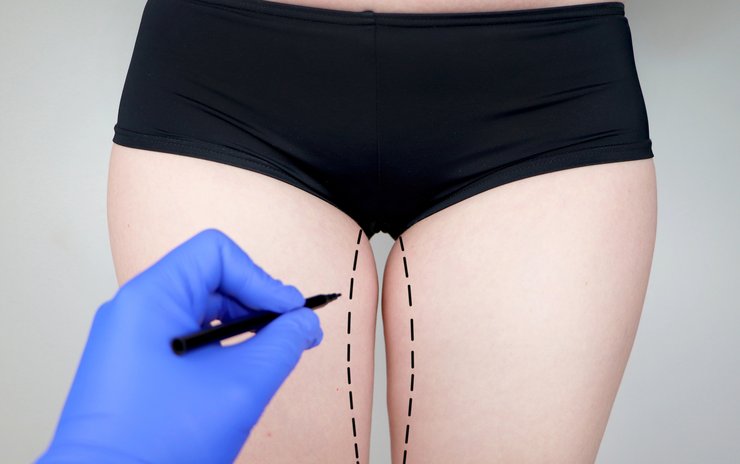
What is a thigh lift?
A thigh lift removes excess skin and fat from the inner or outer thighs and tightens the tissue that remains, producing a firmer, more proportionate contour. It is most commonly performed after significant weight loss, when the skin of the thighs has stretched and will not retract.
The inner thigh is one of the areas least responsive to exercise. Skin there is thin, has relatively little structural support, and is subject to constant movement and friction. Once it has stretched, no amount of strength work will tighten it.
Patients commonly consider a thigh lift for:
- Loose, hanging skin on the inner thighs after major weight loss
- Skin that chafes, rubs or becomes irritated when walking or exercising
- Difficulty with clothing fit, particularly trousers and swimwear
- Thighs that remain disproportionate despite a stable, healthy weight
- Loss of skin tone with age
A thigh lift is a skin procedure, not a slimming procedure. Where the concern is localised fat with good skin quality, liposuction alone may be considered. Where skin is loose, liposuction alone will make it worse.
Am I a suitable candidate?
Generally, candidates are:
- At a stable weight, usually for at least six months
- Physically healthy, with well-controlled medical conditions
- Non-smokers, or willing to stop well before and after surgery — the inner thigh is a demanding area for wound healing and smoking substantially increases the risk of breakdown
- Realistic about scarring, which on the inner thigh is permanent and can be difficult to conceal
- Nutritionally replete, particularly following bariatric surgery
- Able to accommodate several weeks of restricted activity
The inner thigh is a challenging area to operate on. It is a moist, mobile region under constant tension from walking and sitting, close to the groin. Wound healing problems and scar widening are more common here than in most other body contouring sites, and this should be considered carefully before proceeding.
Referral requirement. All patients require a referral from a GP or another specialist before their first consultation. If it is deemed that your surgery is cosmetic in nature and you do not qualify for a Medicare (MBS) item number, a referral is still required, in line with Australian requirements introduced in July 2023. Where it is performed for a functional indication such as recurrent skin infection, a different pathway may apply.
Psychological screening and cooling-off. Where surgery is cosmetic, Dr. Anavekar screens all patients for body dysmorphic disorder (BDD) as part of the assessment. A second consultation is required before any decision to proceed, and a minimum seven-day cooling-off period applies after that second consultation and before surgery can be booked, as required under AHPRA guidelines.
Thigh lift techniques
Medial (inner) thigh lift — short scar
The incision is confined to the groin crease, where it can be concealed by underwear. Suited to patients with limited excess skin in the upper inner thigh only. Because the scar is anchored high, it can be prone to downward migration over time.
Vertical medial thigh lift
An incision runs down the inner thigh, sometimes to the knee. This allows removal of skin along the whole length of the thigh and produces the most significant improvement where excess is extensive. The trade-off is a long, visible scar on the inner thigh.
Lateral (outer) thigh lift
Addresses the outer thigh and is frequently performed as part of a lower body lift rather than in isolation, since the outer thigh is lifted effectively by a circumferential procedure.
Combined with liposuction
Liposuction is often used alongside a thigh lift to reduce volume before the skin is redraped, allowing a better contour than either alone.
Staging with other procedures
Where excess skin affects the abdomen and thighs, a lower body lift is often performed first, with the thighs addressed at a second stage several months later. A body lift alone improves the outer thigh considerably, which sometimes reduces what is needed afterwards.
What is involved
Before surgery
Before surgery, you’ll have more than one consultation, where photographs are taken, incision lines drawn and explained, and the trade-off between scar length and contour improvement discussed — this is a significant consideration in thigh lift surgery. Blood tests may be used to assess nutritional status where relevant.
You must stop smoking at least 6 weeks prior to and 6 weeks following body contouring surgery, and cease medications and supplements that increase bleeding risk.
On the day
Surgery is usually performed under general anaesthetic administered by a specialist anaesthetist, in an accredited private hospital. The length of your operation depends on the technique used, and whether liposuction is combined. Most patients stay 1–3 nights.
Excess skin and fat are removed, the remaining tissue is lifted and secured to the underlying structures to support the result, drains are often placed, and incisions are closed in layers. Compression garments are applied.
After surgery
Early gentle mobilisation is encouraged, however movement will be restricted and uncomfortable initially. Sitting and walking both place tension on inner thigh incisions. Pain relief is prescribed and you will need help at home.
Your recovery
Recovery varies between individuals. The following is a general guide only.
| TIMEFRAME | WHAT TO EXPECT |
|---|---|
| First 48 hours | Discomfort with movement, swelling and bruising. Walking short distances only. Drains may be in place. |
| Week 1 | Movement remains limited and uncomfortable. Sitting for long periods is difficult. Garments worn continuously. |
| Weeks 2–3 | Drains removed. Moving more freely. Many patients still off work. |
| Weeks 3–4 | Return to desk-based work for many patients. No driving until cleared. |
| 6 weeks | Most normal activity resumed once cleared at review. Gradual return to exercise. |
| 3 months | Swelling substantially settled. Contour becoming apparent. |
| 6–12 months | Final contour emerges. Sensation changes improve gradually. |
| 12–24 months | Scars fade and flatten, though inner thigh scars mature slowly. |
Compression garments are typically worn for six to eight weeks. Swelling in the lower legs and ankles is common in the early weeks, as lymphatic drainage from the legs is temporarily disrupted.
Inner thigh scars are under constant tension from walking and sitting, and tend to widen more than scars elsewhere on the body. This is expected rather than a complication, and scar management is discussed at follow-up.
Potential benefits
A thigh lift may:
- Remove loose, hanging skin from the inner or outer thighs
- Reduce chafing, rubbing and skin irritation when walking or exercising
- Improve thigh contour and proportion
- Improve comfort and fit of clothing, particularly trousers and swimwear
- Improve confidence in physical activity
Outcomes vary between individuals and cannot be guaranteed. Results depend on your anatomy, skin quality, healing and the agreed surgical plan. Significant weight change afterwards can alter the result.
Risks and complications
All surgery carries risk. The inner thigh is a demanding area to heal, and complications can occur.
Key risks include:
- General surgical and anaesthetic risks — bleeding, infection, blood clots, and delayed wound healing
- Wound breakdown — more common on the inner thigh than at most other sites, because of tension, movement and moisture
- Scar widening or migration — inner thigh scars commonly widen, and groin-crease scars can drift downwards over time
- Seroma — fluid collection requiring drainage
- Lymphoedema — persistent swelling of the lower leg where lymphatic channels are disrupted
- Altered or lost sensation in the thigh, which may be permanent
- Distortion of the labia or genital area from downward tension on the incision — a recognised risk of medial thigh lift
- Contour irregularity or asymmetry between the two thighs
- Recurrent laxity over time, particularly with weight change
- Dissatisfaction with scar appearance relative to the contour improvement achieved
This is a summary, not a complete list. Dr. Anavekar will discuss the risks relevant to your individual circumstances, medical history and chosen technique in detail during your consultation, and again before you provide informed consent. Please raise any concerns with her directly.
Costs and Medicare
The total cost includes the surgeon's fee, the anaesthetist's fee, hospital fees, garments and follow-up care.
A thigh lift performed for appearance alone does not attract a Medicare rebate. An item number may apply (MBS item 30169) following major weight loss where excess skin is causing recurrent infection, ulceration or significant functional impairment that has not resolved with conservative treatment.
Where an item number applies, private health insurance may contribute to hospital costs, subject to your level of cover and waiting periods.
Eligibility is assessed individually. We encourage you to check with your private health fund and Medicare about your eligibility for relevant rebates ahead of your appointment, as this can give you a clearer picture of your likely out-of-pocket cost. Bring records of skin infections or dermatological treatment, and your weight loss history, as these support the assessment.
You will receive a written quote setting out all costs and any expected rebates before committing to surgery. For questions about fees, contact the practice on 03 9075 0005.
Frequently asked questions
How visible will the scar be?
This depends entirely on technique. A short-scar lift keeps the scar in the groin crease where underwear conceals it, however achieves limited improvement. A vertical lift runs down the inner thigh and is visible in shorts or swimwear, however greater skin reduction is achievable. Choosing between them is the main decision you will make at consultation.
Can I just have liposuction instead?
Liposuction removes fat but relies on skin retracting afterwards. Where skin is already loose, liposuction alone typically makes the appearance worse rather than better. It is important to assess skin quality prior to embarking on liposuction alone.
Will my thighs still touch?
A thigh lift removes skin and improves contour, but it does not fundamentally change your bone structure or fat distribution. Whether the thighs touch depends on your build. This is worth discussing openly at consultation so expectations are clear.
How long before I can walk normally?
Walking short distances starts immediately, but movement is uncomfortable for the first week or two because the incisions are under tension whenever you move. Most patients are moving comfortably by around three to four weeks.
Should I have this at the same time as a body lift?
Sometimes, but often not. Combining extensive procedures increases complication risk. A lower body lift also improves the outer thighs on its own, so it is common to do that first and reassess the inner thighs several months later.
Will the result last?
The skin removed does not come back, but skin continues to age and weight change affects the result. Maintaining a stable weight preserves the outcome.
Why Evolve
Dr. Namrata Anavekar is a Fellow of the Royal Australasian College of Surgeons and a specialist plastic and reconstructive surgeon. She graduated with honours from Monash University and completed the Australian Plastic Surgery Training Program, with rotations through St Vincent's Hospital, The Royal Children's Hospital, The Alfred and The Austin, followed by an international fellowship in Switzerland and France.
Dr. Anavekar is a board member of the Australasian Society of Aesthetic Plastic Surgeons (ASAPS) and has authored multiple research publications. She holds several public and private hospital appointments, and is a professional member of ASAPS, the Australian Society of Plastic Surgeons (ASPS), the Royal Australasian College of Surgeons (RACS), the Australian Medical Association (AMA), and the International Society of Aesthetic Plastic Surgery (ISAPS).
She consults from Bulleen and Sunbury, Melbourne.
Related procedures
Ready to take the next step?
Book a consultation with Dr. Anavekar to discuss your goals in a warm and supportive environment.
Book a ConsultationCall 03 9075 0005Important: In accordance with AHPRA guidelines, a minimum 7-day cooling-off period applies after your second cosmetic surgery consultation and before any procedure. The information on this page is for general educational purposes only and does not constitute medical advice. Individual results vary. A consultation with a Specialist Plastic Surgeon is required to discuss your suitability.