Eyelid Surgery
Eyelid surgery, also known as blepharoplasty, addresses issues relating to skin, muscle, and sometimes fat from the upper and/or lower eyelids. It can improve vision obstructed by drooping eyelids and create a more alert, rested appearance. A consultation is required to assess your individual needs.
What is eyelid surgery?
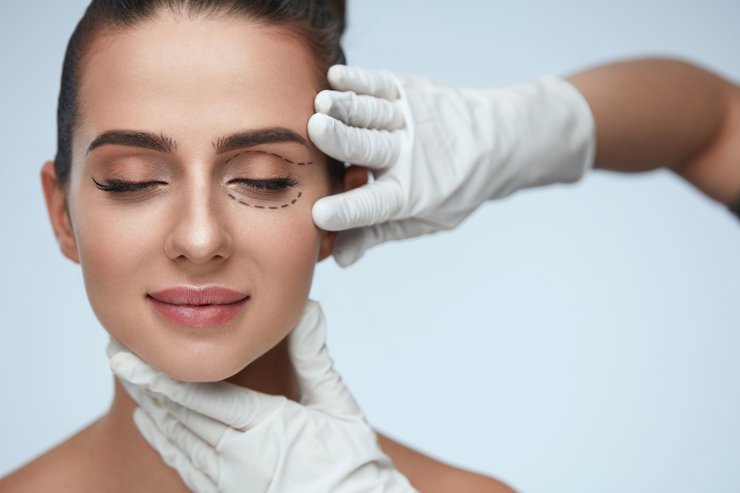
Eyelid surgery, or blepharoplasty, addresses issues relating to skin, fat and muscles of the eyelids. It can address hooding of the upper eyelids, unsatisfactory appearance of the lower eyelids, and correct muscle detachment of the upper eyelid which may contribute to a reduced visual field (known as ptosis surgery).
The skin of the eyelid is the thinnest on the body, and it loses elasticity earlier than skin elsewhere. Combined with weakening of the tissue that holds the fat pads around the eye in place, this can contribute to heaviness of the upper eyelids, as well as fat pad herniation of the lower eyelids.
Patients commonly consider eyelid surgery for:
- Excess skin of the upper eyelid, sometimes resting on the lashes
- Upper lid skin heavy enough to obstruct peripheral vision
- Puffiness or bags beneath the lower lid
- A persistently tired appearance regardless of how well rested they are
- Difficulty applying eye makeup because of overhanging skin
- Asymmetry between the two eyelids
Eyelid surgery is not a facelift or a brow lift. It does not lift the eyebrow or treat crow's feet, and where heavy brows are the real cause of upper lid hooding, a brow lift may be more appropriate. Assessment distinguishes between the two.
When eyelid surgery is medically indicated
Upper eyelid surgery is one of the few procedures in this area with a genuine functional indication and a corresponding Medicare pathway.
Dermatochalasis
Where excess upper eyelid skin rests on the lashes in straight gaze and obstructs the upper or peripheral visual field, surgery to remove it is a functional procedure rather than a cosmetic one. Patients often describe lifting their eyelids with a finger to see better, raising their brows constantly, or headaches from doing so.
Ptosis
A distinct problem, where the eyelid margin itself sits low because the muscle that lifts the lid has weakened or detached. This requires a different operation — tightening or reattaching the levator muscle — rather than simply removing skin. Removing skin alone from a ptotic lid will not correct it.
Where visual field obstruction is documented, typically with a visual field test, a Medicare item number may apply. Criteria are specific and assessment is required — this cannot be determined from a photograph. Bring any optometry or ophthalmology reports to consultation.
Am I a suitable candidate?
Generally, candidates are:
- Troubled by upper lid hooding, lower lid puffiness, or visual obstruction
- In good general health, with well-controlled medical conditions
- Free of active eye disease — dry eye, glaucoma, thyroid eye disease and previous laser eye surgery all affect planning and are asked about specifically
- Non-smokers, or willing to stop before and after surgery
- Realistic about what eyelid surgery changes and what it does not
Dry eye deserves particular mention. Blepharoplasty can worsen pre-existing dry eye, sometimes significantly. If you already experience gritty, burning or watery eyes, tell Dr. Anavekar at consultation — this influences how much skin can safely be removed, and occasionally whether surgery is advisable at all.
Referral requirement. All patients require a referral from a GP or another specialist before their first consultation. If it is deemed that your surgery is cosmetic in nature and you do not qualify for a Medicare (MBS) item number, a referral is still required, in line with Australian requirements introduced in July 2023.
Psychological screening and cooling-off. Where surgery is cosmetic, Dr. Anavekar screens all patients for body dysmorphic disorder (BDD) as part of the assessment. A second consultation is required before any decision to proceed, and a minimum seven-day cooling-off period applies after that second consultation and before surgery can be booked, as required under AHPRA guidelines.
Eyelid surgery techniques
Upper blepharoplasty
An incision is made in the upper eyelid skin, which typically heals well. Excess skin is removed, and a small amount of muscle or fat adjusted where needed. This is the most commonly performed eyelid procedure.
Lower blepharoplasty — transconjunctival
This approach is the one most commonly performed by Dr Anavekar. The incision is made inside the lower eyelid, leaving no external scar. Lower eyelid fat pads are addressed via this approach. Rather than simply removing fat, it can be repositioned to fill the hollow beneath the eye — the tear trough — producing a smoother transition between lid and cheek. Removing fat alone can leave a hollowed, aged appearance in some patients. In cases where there is excess skin, a pinch removal of skin is performed and the resulting scar is typically inconspicuous, just beneath the lash line.
Lower blepharoplasty — transcutaneous
An incision just beneath the lash line allows both excess skin and fat to be addressed. This approach is not used as commonly as the transconjunctival approach as it can have a higher incidence of postoperative ectropion.
Ptosis repair
Where the upper eyelid margin sits low, the levator muscle is tightened or reattached to the tarsus. This is a different operation from skin removal and requires precise assessment, as over- or under-correction is readily visible.
Canthopexy/Canthoplasty
Support to the outer corner of the lower lid, sometimes added to prevent the lid pulling down after lower blepharoplasty.
What is involved
Before surgery
Before surgery, you will have a consultation to assess your medical and surgical history, your goals of surgery and your current issues. A thorough assessment of your eyelids, brow and cheek is undertaken, and clinical photography taken for your records. Your history of dry eye, contact lens use and previous eye surgery is reviewed.
Where surgery is cosmetic, a seven-day cooling-off period applies after your second consultation and before booking surgery. You must cease smoking, and cease medications and supplements that increase bleeding risk.
On the day
Upper eyelid surgery is often performed under local anaesthetic with sedation; lower lid surgery and combined procedures more commonly under general anaesthetic administered by a specialist anaesthetist. In some cases, an overnight stay may be recommended.
Incisions are made in the agreed position, excess skin removed, fat removed or repositioned, and the incisions closed with fine sutures. Cool compresses are applied.
After surgery
Vision may be blurred initially from ointment and swelling. Cool compresses, head elevation and avoiding straining all reduce swelling. Your eyes may feel dry, gritty or watery for some weeks, and lubricating drops are usually prescribed.
Your recovery
Eyelid surgery has one of the quicker recoveries in facial surgery. The following is a general guide only.
| TIMEFRAME | WHAT TO EXPECT |
|---|---|
| First 48 hours | Swelling and bruising build. Cool compresses and head elevation. Vision may be blurred. |
| Week 1 | Sutures typically removed around days five to seven. Swelling settling. |
| Week 2 | Most bruising resolved or concealable with makeup. Many patients return to work. |
| Weeks 3–4 | Swelling largely settled. Scars pink but improving. |
| 6 weeks | Exercise resumed once cleared at review. Contact lenses usually able to be worn again. |
| 3 months | Scars fading. Result becoming settled. |
| 6–12 months | Upper lid scars typically very difficult to see. Final result established. |
Avoid contact lenses, eye rubbing and strenuous activity as directed. Sunglasses are recommended outdoors, both for comfort and to protect healing scars.
Potential benefits
Eyelid surgery may:
- Address hooding and excess skin from the upper eyelid
- Restore peripheral vision where skin was obstructing the visual field
- Reduce puffiness and bags beneath the lower lid
- Produce a more rested, less tired appearance
- Make eye makeup easier to apply
- Improve symmetry between the eyes
Outcomes vary between individuals and cannot be guaranteed. Eyelid surgery does not lift the brow, treat crow's feet, remove dark pigmentation beneath the eyes, or stop the ageing process. Results depend on your anatomy, skin quality, healing and the agreed surgical plan.
Risks and complications
All surgery carries risk. Eyelid surgery is performed on delicate tissue immediately adjacent to the eye, and complications can occur.
Key risks include:
- General surgical and anaesthetic risks — bleeding, infection, and delayed wound healing
- Dry eye — new onset, or worsening of existing dry eye, causing grittiness, burning or watering. May be prolonged and occasionally persistent.
- Difficulty closing the eyes fully — usually temporary, but persistent incomplete closure can threaten the surface of the eye and may require further surgery
- Ectropion or lid retraction — the lower lid pulling downward or outward, a recognised risk of lower blepharoplasty
- Asymmetry between the two eyelids, including crease height and skin removed
- Over- or under-correction, including too much or too little skin or fat removed. Removing too much fat can leave a hollowed appearance.
- Scarring — usually inconspicuous, but scars can thicken, and lower lid scars are less reliably hidden
- Blurred or double vision, usually temporary
- Loss of vision — extremely rare, but a recognised risk of eyelid surgery, usually from bleeding behind the eye
This is a summary, not a complete list. Dr. Anavekar will discuss the risks relevant to your individual circumstances, medical history and chosen technique in detail during your consultation, and again before you provide informed consent. Please raise any concerns with her directly.
Costs and Medicare
The total cost includes the surgeon's fee, the anaesthetist's fee, facility fees and follow-up care, and varies depending on whether upper lids, lower lids or both are treated.
Eyelid surgery performed for appearance alone does not attract a Medicare rebate. An item number may apply (MBS item 45617) to upper eyelid surgery where excess skin is demonstrably obstructing the visual field, and item 45623 to ptosis repair where the lid margin itself is low. In more limited reconstructive circumstances, item 42863 or 45620 may apply to lower eyelid surgery. These criteria are specific and must be met in order to qualify for an item number.
Where an item number applies, private health insurance may contribute to any hospital costs, subject to your level of cover and waiting periods.
We encourage you to check with your private health fund and Medicare about your eligibility for relevant rebates ahead of your appointment, as this can give you a clearer picture of your likely out-of-pocket cost. Bring any optometry or ophthalmology reports to consultation, as these support assessment. You will receive a written quote setting out all costs and any expected rebates before committing to surgery. For questions about fees, contact the practice on 03 9075 0005.
Frequently asked questions
Is eyelid surgery covered by Medicare?
In cases where strict criteria are met, a Medicare item number may apply. Examples include:
- 45617 — upper eyelid reduction, where there is a demonstrated visual impairment, orbital fat herniation, facial nerve palsy, post-traumatic scarring, or to restore symmetry with the other eyelid, supported by photographic or diagnostic evidence in your notes.
- 45623 — correction of ptosis (drooping) of one upper eyelid, by tightening the eyelid retractor muscles or suspending the lid to the brow.
- 42863 — recession of the upper or lower eyelid by open operation to release the lid retractors.
- 45620 — lower eyelid reduction, for orbital fat herniation, facial nerve palsy or post-traumatic scarring, or to restore symmetry, again supported by photographic or diagnostic evidence.
These criteria are specific, and an assessment is required to determine whether your circumstances qualify.
What is the difference between hooding and ptosis?
Hooding is excess skin hanging over the lid. Ptosis is the lid margin itself sitting low because the lifting muscle has weakened. They look similar but need different operations — removing skin will not correct ptosis.
Will the scars be visible?
Upper eyelid scars sit within the natural crease and typically become very difficult to see. Lower lid scars either sit inside the lid with no external mark, or just beneath the lash line where they are usually inconspicuous.
I have dry eyes — can I still have surgery?
Possibly, but tell Dr. Anavekar. Blepharoplasty can worsen dry eye, sometimes significantly. Existing dry eye influences how much skin can safely be removed and occasionally whether surgery is advisable.
How long before I look presentable?
Most patients return to work at around two weeks, when bruising is usually resolved or concealable with makeup. Swelling continues settling for several weeks after that.
Will eyelid surgery get rid of my crow's feet or dark circles?
Not necessarily. Although there may be mild improvement in crow's feet, they are expression lines needing different treatment. There are several causes for lower eyelid dark circles, which are often better served by non-surgical treatments.
Should I have a brow lift instead?
Sometimes. Where heavy or descended brows are the real cause of upper lid hooding, removing lid skin alone can pull the brow down further and worsen the appearance. Assessment distinguishes between the two.
Why Evolve
Dr. Namrata Anavekar is a Fellow of the Royal Australasian College of Surgeons and a specialist plastic and reconstructive surgeon. She graduated with honours from Monash University and completed the Australian Plastic Surgery Training Program, with rotations through St Vincent's Hospital, The Royal Children's Hospital, The Alfred and The Austin, followed by an international fellowship in Switzerland and France.
Dr. Anavekar is a board member of the Australasian Society of Aesthetic Plastic Surgeons (ASAPS) and has authored multiple research publications. She holds several public and private hospital appointments, and is a professional member of ASAPS, the Australian Society of Plastic Surgeons (ASPS), the Royal Australasian College of Surgeons (RACS), the Australian Medical Association (AMA), and the International Society of Aesthetic Plastic Surgery (ISAPS).
She consults from Bulleen and Sunbury, Melbourne.
Related procedures
Ready to take the next step?
Book a consultation with Dr. Anavekar to discuss your goals in a warm and supportive environment.
Book a ConsultationCall 03 9075 0005Important: In accordance with AHPRA guidelines, a minimum 7-day cooling-off period applies after your second cosmetic surgery consultation and before any procedure. The information on this page is for general educational purposes only and does not constitute medical advice. Individual results vary. A consultation with a Specialist Plastic Surgeon is required to discuss your suitability.