
Body Lift Surgery
Body lift surgery addresses loose skin and excess tissue around the waist, hips, thighs, and buttocks. It is most commonly performed following massive weight loss. A consultation is required to assess your individual suitability.
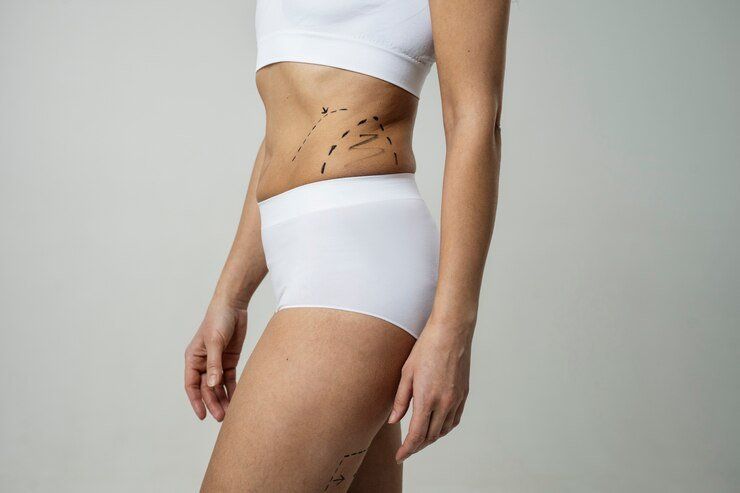
What is a body lift?
A body lift removes excess, loose skin from around the entire circumference of the lower torso — abdomen, hips, flanks, lower back and buttocks — and lifts the tissue that remains. It is one of the more extensive of the body contouring procedures, and is most often performed after major weight loss.
When a significant amount of weight is lost, skin that has been stretched over years often does not completely retract in line with the volume of weight loss. What remains is a circumferential belt of loose skin and soft tissue that fails to resolve with exercise. This is a physical problem as much as an aesthetic one: skin folds trap moisture, chafe, and become inflamed or infected.
Patients commonly consider a body lift after:
- Bariatric surgery — gastric sleeve, bypass or band
- Substantial weight loss through diet and exercise
- Weight loss following medication, including GLP-1 medications
- Multiple pregnancies combined with significant weight change
A body lift addresses the lower torso in one operation. Where excess skin also affects the arms, thighs, breasts or face, those are treated separately — often staged over time.
This is major surgery. A body lift involves a long incision that travels circumferentially around the body, a hospital stay of several days, and a significant recovery period and associated restrictions. It is not a procedure to approach lightly.
Am I a suitable candidate?
Timing matters more with a body lift than with almost any other procedure. Generally, candidates are:
- Weight stable — usually for at least six to twelve months. Operating before weight has plateaued risks further loose skin developing afterwards. It is also a Medicare requirement to ensure weight stability for 6 months.
- Nutritionally replete — protein, iron, vitamin B12, vitamin D and zinc levels should be optimised, as bariatric patients are frequently deficient and this directly affects wound healing
- Physically healthy, with well-controlled medical conditions
- Non-smokers, or willing to stop well before and after surgery — smoking substantially increases the risk of wound breakdown in a procedure with this much incision length
- Realistic about extensive, permanent scarring
- Able to arrange several weeks of help at home and time away from work
If you have had bariatric surgery, bring your recent blood results and details of your procedure and current weight trend to your consultation.
Referral requirement. All patients require a referral from a GP or another specialist before their first consultation. If it is deemed that your surgery is cosmetic in nature and you do not qualify for a Medicare (MBS) item number, a referral is still required, in line with Australian requirements introduced in July 2023. Where it is performed for a functional indication such as recurrent skin infection, a different pathway may apply.
Psychological screening and cooling-off. Where surgery is cosmetic, Dr. Anavekar screens all patients for body dysmorphic disorder (BDD) as part of the assessment. A second consultation is required before any decision to proceed, and a minimum seven-day cooling-off period applies after that second consultation and before surgery can be booked, as required under AHPRA guidelines.
Body lift techniques
Lower body lift (belt lipectomy)
The standard technique. An incision runs right around the lower torso, like a belt. Excess skin and fat are removed from the abdomen, hips, flanks, lower back and buttocks, and the remaining tissue is lifted. This simultaneously flattens the abdomen, lifts the outer thighs and buttocks, and removes the back rolls.
Anterior body lift
Addresses the front and sides only, without extending across the back. Suited to patients whose excess is concentrated anteriorly.
Fleur-de-lis component
Where there is significant horizontal excess as well as vertical, a vertical midline incision is added to the abdomen. This allows the waist to be narrowed considerably, at the cost of a visible vertical scar.
Combined with muscle repair
Where the abdominal muscles have separated, repair is performed at the same time, as in an abdominoplasty.
Staging
Body contouring after major weight loss is frequently staged across two or more operations, separated by several months. Attempting too much in a single procedure can increase the risk of complications considerably. Dr. Anavekar will discuss a sequence that suits your priorities and safety.
What is involved
Before surgery
Before surgery, you’ll have more than one consultation. Photographs and measurements are taken, incision lines are drawn and explained, and if more than one procedure is needed, Dr. Anavekar will discuss a staging plan with you. Blood tests may be used to assess your nutritional status, so that any deficiencies can be addressed beforehand.
You must cease smoking, and cease medications and supplements that increase bleeding risk. Because of the extent of this surgery, your risk of blood clots is assessed carefully and preventive measures planned.
On the day
Surgery is usually performed under general anaesthetic administered by a specialist anaesthetist, in an accredited private hospital. The length of your operation depends on the extent of the lift, whether muscle repair is included, and your individual anatomy. You will be repositioned during surgery to access the back. Most patients stay several nights.
Excess skin and fat are removed circumferentially, tissue is lifted and secured, drains are placed, and the incisions are closed in layers. A compression garment is applied.
After surgery
Early mobilisation is encouraged to reduce clot risk. Drains typically remain for some days and occasionally go home with you, with instructions for managing them. Pain relief is prescribed. You will need substantial help at home.
Your recovery
A body lift has the longest recovery of the body contouring procedures. The following is a general guide only.
| TIMEFRAME | WHAT TO EXPECT |
|---|---|
| Hospital stay | Several nights. Assisted mobilisation from day one. Drains in place. |
| Week 1–2 | Significant discomfort and fatigue. Limited mobility. Drains may remain. Full-time help needed at home. |
| Weeks 3–4 | Drains removed. Moving more freely. Still no lifting or driving. Garment worn continuously. |
| Weeks 4–6 | Many patients return to desk-based work, often part-time initially. |
| 6–8 weeks | Light activity resumed once cleared at review. No heavy lifting. |
| 3 months | Gradual return to most exercise, guided by review. |
| 6–12 months | Swelling settles. Numbness along the incision improves gradually. |
| 18–24 months | Scars fade and flatten. Final appearance emerges. |
Compression garments are typically worn for 6–8 weeks. Fatigue after this procedure is prolonged and often surprises patients — plan for a longer period of reduced capacity than you think you will need.
Wound healing problems can occur after a body lift, simply because of the incision length. Some patients experience areas of delayed healing that require dressings for several weeks. This is of course managed if it was to occur.
Potential benefits
A body lift may:
- Remove circumferential excess skin from the lower torso
- Resolve chronic skin irritation, rashes and infection within skin folds
- Lift the buttocks and outer thighs
- Flatten the abdomen and remove flank and back rolls
- Improve mobility and comfort during exercise
- Improve fit of clothing, often substantially
- Help patients feel their body reflects the weight loss they have achieved
Outcomes vary between individuals and cannot be guaranteed. Results depend on your anatomy, skin quality, nutritional status, healing and the agreed surgical plan. Significant weight change afterwards can alter the result.
Risks and complications
All surgery carries risk. A body lift is major surgery with a long incision, performed under general anaesthetic, and carries a higher complication rate than smaller procedures.
Key risks include:
- General surgical and anaesthetic risks — bleeding, infection, and delayed wound healing
- Blood clots — deep vein thrombosis and pulmonary embolism. Risk is meaningful with a procedure of this length and preventive measures are used.
- Wound breakdown — relatively common given the incision length, particularly at the hips and where incisions meet. May require dressings for weeks.
- Seroma — fluid collection beneath the skin, common after this procedure, sometimes requiring repeated drainage
- Extensive permanent scarring that travels around the body, which may thicken, widen or become raised
- Altered or lost sensation across the treated areas, which may be permanent
- Contour irregularities, asymmetry or "dog ears", often requiring a revision procedure
- Tissue loss where blood supply to skin edges is compromised, particularly in smokers
- Prolonged fatigue and slow return to normal function
- Dissatisfaction with the aesthetic outcome, including scar position
Revision surgery is more common after body lift than after most procedures, and should be anticipated as a possibility rather than treated as a failure.
This is a summary, not a complete list. Dr. Anavekar will discuss the risks relevant to your individual circumstances, medical history and chosen technique in detail during your consultation, and again before you provide informed consent. Please raise any concerns with her directly.
Costs and Medicare
The total cost includes the surgeon's fee, the anaesthetist's fee, hospital fees for a multi-night stay, garments and follow-up care. Body lift is among the more significant procedures in terms of both surgical time and hospital resources.
A Medicare item number may apply in some circumstances following major weight loss. The relevant MBS items are typically 30166 (abdominal), 30169 (non-abdominal) or 30177/30179.
Where an item number applies, private health insurance may contribute to hospital costs, subject to your level of cover and waiting periods. Given the hospital component of this procedure, health fund cover makes a considerable difference.
Eligibility is assessed individually. We encourage you to check with your private health fund and Medicare about your eligibility for relevant rebates ahead of your appointment, as this can give you a clearer picture of your likely out-of-pocket cost. Bring records of skin infections, dermatology or GP treatment, and your weight loss history, as these support the assessment.
You will receive a written quote setting out all costs and any expected rebates before committing to surgery. For questions about fees or health fund cover, contact the practice on 03 9075 0005.
Frequently asked questions
How long after weight loss should I wait?
Usually at least six to twelve months of stable weight. Operating before your weight has settled risks further loose skin developing afterwards, and increases the chance of needing revision.
Is a body lift covered by Medicare?
It can be in some circumstances, most commonly where an overhanging apron of skin causes recurrent infection or ulceration that has not resolved with other treatment. Eligibility is assessed individually and documentation of your symptoms helps.
How is a body lift different from a tummy tuck?
An abdominoplasty addresses the front of the abdomen. A body lift extends the same principle right around the torso, also treating the hips, flanks, lower back and buttocks. A body lift is considerably larger surgery with a longer recovery.
Will I need more than one operation?
Often, yes. Body contouring after major weight loss is commonly staged, with the lower body treated first and arms, thighs or breasts addressed in a later procedure several months on.
How bad will the scarring be?
Extensive and permanent. The main incision travels around the body. Scars are placed to sit within underwear where possible, but this procedure trades significant scarring for significant contour improvement, and that trade-off should be clearly understood before proceeding.
I had bariatric surgery — is there anything specific I should know?
Yes. Nutritional deficiencies are common after bariatric surgery and directly affect wound healing. Blood levels are checked and corrected before surgery. Bring your recent results and details of your bariatric procedure to consultation.
How long will I be off work?
Most patients need at least four to six weeks, and longer for physical work. Fatigue after this procedure is prolonged, so plan for a staged return rather than a hard stop date.
Why Evolve
Dr. Namrata Anavekar is a Fellow of the Royal Australasian College of Surgeons and a specialist plastic and reconstructive surgeon. She graduated with honours from Monash University and completed the Australian Plastic Surgery Training Program, with rotations through St Vincent's Hospital, The Royal Children's Hospital, The Alfred and The Austin, followed by an international fellowship in Switzerland and France.
Dr. Anavekar is a board member of the Australasian Society of Aesthetic Plastic Surgeons (ASAPS) and has authored multiple research publications. She holds several public and private hospital appointments, and is a professional member of ASAPS, the Australian Society of Plastic Surgeons (ASPS), the Royal Australasian College of Surgeons (RACS), the Australian Medical Association (AMA), and the International Society of Aesthetic Plastic Surgery (ISAPS).
She consults from Bulleen and Sunbury, Melbourne.
Related procedures
Ready to take the next step?
Book a consultation with Dr. Anavekar to discuss your weight loss journey and contouring options in a warm and supportive environment.
Book a ConsultationCall 03 9075 0005Important: In accordance with AHPRA guidelines, a minimum 7-day cooling-off period applies after your second cosmetic surgery consultation and before any procedure. The information on this page is for general educational purposes only and does not constitute medical advice. Individual results vary. A consultation with a Specialist Plastic Surgeon is required to discuss your suitability.