Arm Lift Surgery
Arm lift surgery, also known as brachioplasty, removes excess skin and fat from the upper arms to improve contour and shape. It is commonly sought following weight loss or due to age-related changes. A consultation is necessary to assess your individual suitability.
What is an arm lift?
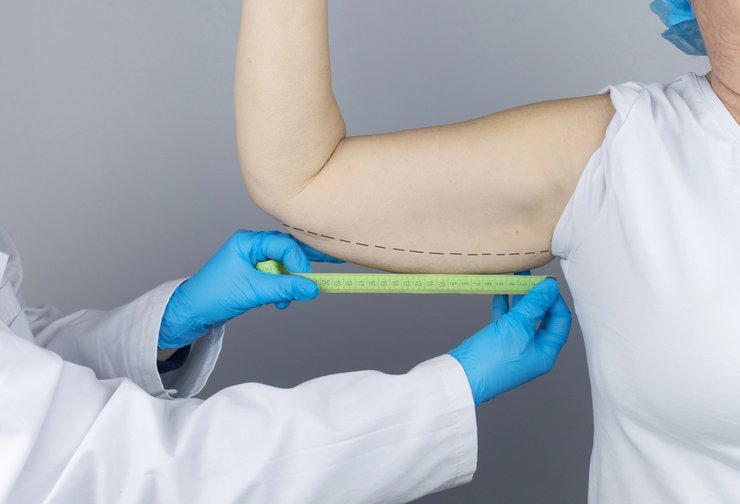
An arm lift, or brachioplasty, removes excess skin and fat from the upper arm between the armpit and the elbow, and tightens the tissue that remains. It addresses loose, hanging skin that does not respond to exercise.
Upper arm skin loses elasticity with age and stretches with significant weight gain. Once stretched, it often does not fully retract — building underlying muscle size and tone beneath loose skin does not tighten it, and often makes the contrast more noticeable.
Patients commonly consider an arm lift for:
- Loose, hanging skin on the upper arms after major weight loss
- Skin laxity that has developed with age
- Difficulty with sleeve fit, or avoiding sleeveless clothing
- Skin that chafes or rubs against the body
- Arms that remain disproportionate despite a stable weight and regular exercise
A significant consideration is the visible scar following a traditional arm lift. For patients with mild to moderate skin laxity and good skin quality, a mini arm lift may be an option — the incision is much shorter and concealed within the armpit, resulting in significantly less visible scarring. The scar runs along the inner arm and is not easily concealed. This trade-off is the central consideration, and it is worth being clear with yourself about which bothers you more before consultation.
Am I a suitable candidate?
Generally, candidates are:
- At a stable weight, usually for at least six months
- Physically healthy, with well-controlled medical conditions
- Non-smokers, or willing to stop well before and after surgery
- Realistic about the scar, which is long, permanent and visible when the arms are raised
- Nutritionally replete, particularly following bariatric surgery
- Able to manage several weeks of restricted arm use
Where skin quality is good and the concern is localised fat, liposuction alone may achieve a satisfactory result without a long scar. Where skin is loose, liposuction alone will not help and may worsen the appearance. Where laxity is mild to moderate and skin quality is good, a mini arm lift may also be considered, using a much shorter incision concealed within the armpit. Assessment of your skin quality at consultation determines which is appropriate.
Referral requirement. All patients require a referral from a GP or another specialist before their first consultation. If it is deemed that your surgery is cosmetic in nature and you do not qualify for a Medicare (MBS) item number, a referral is still required, in line with Australian requirements introduced in July 2023. Where it is performed for a functional indication such as recurrent skin infection, a different pathway may apply.
Psychological screening and cooling-off. Where surgery is cosmetic, Dr. Anavekar screens all patients for body dysmorphic disorder (BDD) as part of the assessment. A second consultation is required before any decision to proceed, and a minimum seven-day cooling-off period applies after that second consultation and before surgery can be booked, as required under AHPRA guidelines.
Arm lift techniques
Standard brachioplasty
An incision runs along the inner or back surface of the upper arm, from the armpit towards the elbow. Excess skin and fat are removed and the remaining skin redraped. This achieves the most significant improvement and is the usual technique after major weight loss.
Mini brachioplasty (short scar)
The incision is limited to the armpit. Suited only to patients with mild laxity confined to the upper portion of the arm. Leaves a well-concealed scar, but achieves limited improvement and is not appropriate where excess extends towards the elbow.
Extended brachioplasty
Where excess skin continues onto the side of the chest, the incision extends from the arm down onto the chest wall. Common after major weight loss.
Liposuction-assisted brachioplasty
Liposuction reduces fat volume before the skin is removed and redraped, often producing a better contour than skin excision alone.
Liposuction alone
Where skin elasticity is genuinely good and the concern is fat rather than laxity, liposuction alone avoids a long scar. This suits a minority of patients and is assessed carefully, as overestimating skin quality leads to a poor result.
What is involved
Before surgery
Before surgery, you’ll have more than one consultation. Photographs are taken, the incision is drawn on your arm and explained, and Dr. Anavekar will discuss the scar-versus-contour trade-off with you. Blood tests may be used to assess nutritional status where relevant.
You must cease smoking, and cease medications and supplements that increase bleeding risk.
On the day
Surgery is usually performed under general anaesthetic administered by a specialist anaesthetist, in an accredited private hospital. The length of your operation depends on the technique used and whether liposuction is combined. It is often recommended to stay 1–2 nights to ensure strict elevation and to monitor drain output when drains are used.
Excess skin and fat are removed, the tissue is redraped and secured, and the incisions are closed in layers. Compression garments or bandages are applied to the arms.
After surgery
Your arms will be swollen and movement restricted. You will be advised to keep the arms elevated where possible to reduce swelling. Pain relief is prescribed. Everyday tasks involving reaching, lifting or overhead movement will be difficult initially, so please arrange help.
Your recovery
Recovery varies between individuals. The following is a general guide only.
| TIMEFRAME | WHAT TO EXPECT |
|---|---|
| First 48 hours | Swelling, bruising and tightness. Arms kept elevated. Reaching and lifting difficult. |
| Week 1 | Swelling peaks then begins to settle. Garments worn continuously. Help needed with daily tasks. |
| Weeks 2–3 | Many patients return to desk-based work. No lifting or overhead activity. |
| Weeks 4–6 | Range of movement improving. Light activity resumed. |
| 6 weeks | Most normal activity resumed once cleared at review, including gradual upper body exercise. |
| 3 months | Swelling largely settled. Contour apparent. |
| 6–12 months | Sensation changes improve. Final contour established. |
| 12–24 months | Scars fade and flatten, though arm scars mature slowly. |
Compression garments are typically worn for six to eight weeks. Swelling in the forearms and hands is common early on, as drainage from the arm is temporarily disrupted — elevation helps considerably.
Arm scars are among the slower scars to mature and can remain pink or raised for a year or more. Scar management is discussed at follow-up, and silicone products are often recommended.
Potential benefits
An arm lift may:
- Remove loose, hanging skin from the upper arms
- Improve arm contour and definition
- Reduce chafing and skin irritation where the arm meets the body
- Improve fit of sleeves and clothing
- Increase confidence in short-sleeved or sleeveless clothing
Outcomes vary between individuals and cannot be guaranteed. Results depend on your anatomy, skin quality, healing and the agreed surgical plan. Skin continues to age, and significant weight change can alter the result.
Risks and complications
All surgery carries risk, and complications can occur.
Key risks include:
- General surgical and anaesthetic risks — bleeding, infection, blood clots, and delayed wound healing
- Visible, permanent scarring along the inner arm, which may thicken, widen or become raised — this is the most common source of dissatisfaction after arm lift
- Wound breakdown, particularly near the armpit where movement places tension on the incision
- Altered or lost sensation in the arm and forearm, which may be permanent
- Injury to nerves in the arm, including the medial antebrachial cutaneous nerve, causing numbness or discomfort
- Lymphoedema — persistent swelling of the forearm or hand where lymphatic channels are disrupted
- Seroma or haematoma requiring drainage
- Contour irregularity or asymmetry between the two arms
- Restricted shoulder movement during healing, occasionally persisting
- Recurrent laxity over time with ageing or weight change
This is a summary, not a complete list. Dr. Anavekar will discuss the risks relevant to your individual circumstances, medical history and chosen technique in detail during your consultation, and again before you provide informed consent. Please raise any concerns with her directly.
Costs and Medicare
The total cost includes the surgeon's fee, the anaesthetist's fee, hospital or day-surgery fees, garments and follow-up care.
An arm lift performed for appearance alone does not attract a Medicare rebate. An item number may apply (MBS item 30169) following major weight loss where excess skin is causing recurrent infection, ulceration or significant functional impairment that has not resolved with conservative treatment.
Where an item number applies, private health insurance may contribute to hospital costs, subject to your level of cover and waiting periods.
Eligibility is assessed individually. We encourage you to check with your private health fund and Medicare about your eligibility for relevant rebates ahead of your appointment, as this can give you a clearer picture of your likely out-of-pocket cost. Bring records of skin infections or dermatological treatment, and your weight loss history, as these support the assessment.
You will receive a written quote setting out all costs and any expected rebates before committing to surgery. For questions about fees, contact the practice on 03 9075 0005.
Frequently asked questions
Where exactly will the scar be, and how visible is it?
Along the inner or back surface of the upper arm, from the armpit towards the elbow. It is not easily concealed — it is visible when the arms are raised or in sleeveless clothing. Being clear-eyed about this before surgery is important, as scar appearance is the most common source of dissatisfaction after arm lift.
Can I avoid the scar with liposuction only?
It depends on your skin quality as to whether this is appropriate. Liposuction removes fat but relies on skin retracting afterwards. Where skin is already loose, liposuction alone typically worsens the appearance. In select candidates with only mild to moderate laxity and good skin quality, a mini arm lift may be suitable — this uses a much shorter incision concealed within the armpit. Where laxity is more advanced, a traditional arm lift is generally required to achieve meaningful improvement. Your skin quality is assessed at consultation.
Will an arm lift make my arms thinner?
It removes loose skin and, where liposuction is combined, some fat. It does not change muscle bulk or your underlying frame. The result is a firmer, better-defined contour rather than a substantially thinner arm.
How soon can I lift things or exercise?
Reaching and lifting are restricted for several weeks. Light activities and driving are usually possible after around two weeks. Most patients resume normal activity around six weeks, with upper body exercise introduced gradually after that, once cleared at review.
Can an arm lift be combined with other procedures?
Yes, and it is often performed alongside other body contouring after weight loss. However, combining extensive procedures increases risk, so staging is frequently recommended. Dr. Anavekar will advise on a safe sequence.
Will the loose skin come back?
The skin removed does not return. Skin does continue to age, and significant weight change can produce new laxity. A stable weight preserves the result.
Why Evolve
Dr. Namrata Anavekar is a Fellow of the Royal Australasian College of Surgeons and a specialist plastic and reconstructive surgeon. She graduated with honours from Monash University and completed the Australian Plastic Surgery Training Program, with rotations through St Vincent's Hospital, The Royal Children's Hospital, The Alfred and The Austin, followed by an international fellowship in Switzerland and France.
Dr. Anavekar is a board member of the Australasian Society of Aesthetic Plastic Surgeons (ASAPS) and has authored multiple research publications. She holds several public and private hospital appointments, and is a professional member of ASAPS, the Australian Society of Plastic Surgeons (ASPS), the Royal Australasian College of Surgeons (RACS), the Australian Medical Association (AMA), and the International Society of Aesthetic Plastic Surgery (ISAPS).
She consults from Bulleen and Sunbury, Melbourne.
Related procedures
Ready to take the next step?
Book a consultation with Dr. Anavekar to discuss your goals in a warm and supportive environment.
Book a ConsultationCall 03 9075 0005Important: In accordance with AHPRA guidelines, a minimum 7-day cooling-off period applies after your second cosmetic surgery consultation and before any procedure. The information on this page is for general educational purposes only and does not constitute medical advice. Individual results vary. A consultation with a Specialist Plastic Surgeon is required to discuss your suitability.