
Facelift Surgery
Facelift surgery addresses visible signs of ageing in the face and neck, including loss of skin firmness, deep creases, and loss of muscle tone. The procedure repositions deeper tissues and removes excess skin to restore a more youthful, natural appearance. A consultation is essential to discuss your goals and suitability.
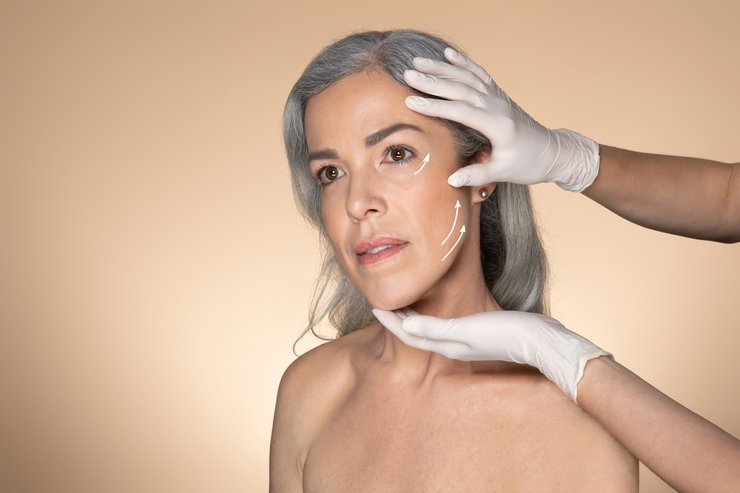
What is a facelift?
A facelift, or rhytidectomy, repositions and tightens the deeper structures of the face and removes excess skin, addressing loss of definition in the lower face and jawline. Modern facelift surgery works on the underlying tissue layer — the SMAS — rather than simply pulling skin tight, which is what produces a natural result rather than an operated appearance.
Facial ageing is not only a matter of skin. Beneath the skin, fat pads descend and deflate, ligaments that support the face weaken, and bone volume is gradually lost. Skin loses elasticity on top of all this. A facelift addresses descent and laxity; it does not address skin texture, pigmentation or fine lines, which are treated separately.
Patients commonly consider a facelift for:
- Loss of firmness in the mid-face and reduced cheek definition
- Deepening folds between the nose and mouth
- Jowls forming along the jawline
- Loss of a defined jawline and neck contour
- Facial appearance that no longer reflects how they feel
A facelift addresses the lower face and neck. It does not lift the brow or treat the eyelids. Where those areas are also a concern, brow or eyelid surgery may be discussed as separate or combined procedures.
Am I a suitable candidate?
There is no correct age for a facelift. Suitability depends on the degree of laxity, your skin quality and your general health rather than a number.
Generally, candidates are:
- Experiencing changes in the lower face, jawline or neck that concern them
- In good general health, with well-controlled medical conditions — particularly blood pressure, as poorly controlled hypertension increases bleeding risk
- Non-smokers, or willing to stop well before and after surgery — smoking substantially increases the risk of skin loss in facelift surgery specifically
- Of reasonable skin elasticity
- Realistic in expectations, understanding that surgery repositions tissue rather than making someone look like a different person
Referral requirement. All patients require a referral from a GP or another specialist before their first consultation. If it is deemed that your surgery is cosmetic in nature and you do not qualify for a Medicare (MBS) item number, a referral is still required, in line with Australian requirements introduced in July 2023.
Psychological screening and cooling-off. Where surgery is cosmetic, Dr. Anavekar screens all patients for body dysmorphic disorder (BDD) as part of the assessment. A second consultation is required before any decision to proceed, and a minimum seven-day cooling-off period applies after that second consultation and before surgery can be booked, as required under AHPRA guidelines.
Facelift techniques
SMAS facelift
The SMAS is a layer of fibrous tissue and muscle beneath the skin. Tightening and repositioning this layer, rather than the skin alone, supports the result over the longer term and avoids the tight, pulled appearance associated with older skin-only techniques. This is the foundation of modern facelift surgery.
Deep plane facelift
The dissection is carried beneath the SMAS, releasing the ligaments that tether the face. This allows the mid-face and cheek to be repositioned vertically as a single unit. It is technically more demanding and is suited to patients with significant mid-face descent.
Mini facelift / short scar
A shorter incision addressing early jowling and mild laxity, with a more limited dissection. Recovery is shorter, but so is the extent of correction — it is not a substitute for a full facelift where laxity is significant.
Facelift with neck lift
The lower face and neck age together, and a facelift is very commonly combined with a neck lift to address platysmal banding and submental fullness. Treating the face without the neck can produce an unbalanced result.
Adjunctive procedures
Fat grafting is often combined to restore lost volume in the cheeks and temples, since repositioning tissue alone does not replace volume that has deflated. Eyelid surgery, brow lift and skin resurfacing may also be discussed depending on your concerns.
What is involved
Before surgery
Before surgery, you’ll have more than one consultation, where your facial anatomy is assessed, photographs taken, and incision placement explained — facelift incisions are designed to sit within the hairline and the natural contours around the ear, where they settle inconspicuously.
A seven-day cooling-off period applies after your second consultation and before any booking for cosmetic surgery. Blood pressure is reviewed and optimised where necessary. You must cease smoking, and pause medications or supplements that can increase bleeding risk.
On the day
Surgery is usually performed under general anaesthetic administered by a specialist anaesthetist, in an accredited private hospital. The length of your operation depends on the technique used and whether a neck lift or other procedures are combined. Most patients stay overnight.
Incisions are made in the agreed position, the SMAS layer is repositioned and secured, excess skin is removed without tension, and the incisions are closed in layers. Drains are sometimes used, and a supportive dressing applied.
After surgery
Your face will be swollen and bruised, and this is more pronounced than most patients anticipate. Sleeping with the head elevated is important. Pain after facelift is usually less than expected — tightness and numbness are the dominant sensations.
Your recovery
Recovery varies between individuals. The following is a general guide only.
| TIMEFRAME | WHAT TO EXPECT |
|---|---|
| First 48 hours | Swelling and bruising build. Head kept elevated. Dressings in place. Tightness and numbness rather than sharp pain. |
| Week 1 | Swelling peaks around days three to five, then begins to settle. Sutures around the ear typically removed towards the end of week one. |
| Week 2 | Bruising fading and often concealable with makeup. Many patients feel presentable to close family but not yet socially. |
| Weeks 3–4 | Most patients comfortable returning to work and social activity. Residual swelling still present but not obvious to others. |
| 6 weeks | Exercise gradually resumed once cleared at review. |
| 3 months | Most swelling resolved. Numbness improving. Result becoming apparent. |
| 6–12 months | Final result settles. Sensation returns gradually. Scars soften. |
Most patients plan around two to three weeks away from social and professional commitments. Numbness in front of and below the ear is normal and can persist for months — it resolves gradually in the large majority of patients.
Sleeping elevated for the first two weeks, avoiding vigorous activity, and protecting scars from sun exposure all materially affect the result.
Potential benefits
A facelift may:
- Improve firmness and definition in the mid-face, jawline and neck
- Restore definition to the jawline
- Soften deep folds between the nose and mouth
- Reposition descended cheek and mid-face tissue
- Produce a rested, less tired appearance
Outcomes vary between individuals and cannot be guaranteed. A facelift does not stop ageing — it repositions tissue at a point in time, and ageing continues from there. It does not improve skin texture, pigmentation, sun damage or fine lines, which require separate treatment.
Risks and complications
All surgery carries risk. Facelift surgery is performed close to important facial structures, and complications can occur.
Key risks include:
- General surgical and anaesthetic risks — bleeding, infection, and delayed wound healing
- Haematoma — a collection of blood beneath the skin, the most common early complication after facelift, sometimes requiring return to theatre. Risk is higher with uncontrolled blood pressure.
- Facial nerve injury — causing weakness of facial movement. Usually temporary, but permanent weakness is a recognised risk.
- Altered or lost sensation, particularly around the ear. Numbness is normal early and usually improves, but some change may be permanent.
- Skin loss where blood supply is compromised — the single greatest risk factor is smoking
- Scarring — permanent, and in some patients thickened, widened or visible. Poor scarring in front of or behind the ear is difficult to conceal.
- Hair loss around the incision lines within the hairline
- Earlobe distortion — a pulled or "pixie ear" appearance from tension on the closure
- Asymmetry between the two sides of the face
- Dissatisfaction with the aesthetic outcome, including the degree of change achieved
This is a summary, not a complete list. Dr. Anavekar will discuss the risks relevant to your individual circumstances, medical history and chosen technique in detail during your consultation, and again before you provide informed consent. Please raise any concerns with her directly.
Costs
The total cost includes the surgeon's fee, the anaesthetist's fee, hospital fees and follow-up care, and varies considerably with the technique used and whether a neck lift, eyelid surgery or fat grafting are combined.
Facelift surgery performed for cosmetic reasons does not attract a Medicare rebate, and private health insurance does not generally contribute. Where facial surgery is performed for reconstructive reasons — following trauma, cancer surgery or facial palsy — a Medicare item number may apply.
You will receive a written quote setting out all costs before committing to surgery, as part of the informed financial consent process. For questions about fees, contact the practice on 03 9075 0005.
Frequently asked questions
How long does a facelift last?
A facelift repositions tissue at a point in time; ageing then continues from that new starting point. Many patients find the benefit persists for a decade or more, but there is no fixed figure, and skin quality, genetics, sun exposure and smoking all influence how the result holds.
Will I look pulled or unnatural?
That appearance comes from older techniques that tightened skin alone. Modern SMAS and deep plane techniques reposition the deeper tissue layer and close the skin without tension, which is what produces a natural result.
How long before I can go back to work?
Most patients plan two to three weeks. Bruising is usually concealable with makeup by around two weeks. Residual swelling persists longer but is generally not obvious to others.
Where will the scars be?
Within the hairline at the temple, following the natural contours in front of and behind the ear, and into the hairline at the back. They are designed to sit where they settle inconspicuously.
Do I need a neck lift as well?
Often, yes. The lower face and neck age together, and treating the face alone can leave an unbalanced result. Whether the neck needs separate attention is assessed at consultation.
Can a facelift replace injectables or skin treatments?
No — they do different things. A facelift addresses loss of facial firmness and descent. It does not improve skin texture, pigmentation, sun damage or fine lines, which need skin treatments. Volume loss is addressed with fat grafting or fillers.
What is the youngest age for a facelift?
There is no set age. Suitability depends on the degree of laxity rather than a number, and some patients are better served by non-surgical treatment or by waiting.
Why Evolve
Dr. Namrata Anavekar is a Fellow of the Royal Australasian College of Surgeons and a specialist plastic and reconstructive surgeon. She graduated with honours from Monash University and completed the Australian Plastic Surgery Training Program, with rotations through St Vincent's Hospital, The Royal Children's Hospital, The Alfred and The Austin, followed by an international fellowship in Switzerland and France.
Dr. Anavekar is a board member of the Australasian Society of Aesthetic Plastic Surgeons (ASAPS) and has authored multiple research publications. She holds several public and private hospital appointments, and is a professional member of ASAPS, the Australian Society of Plastic Surgeons (ASPS), the Royal Australasian College of Surgeons (RACS), the Australian Medical Association (AMA), and the International Society of Aesthetic Plastic Surgery (ISAPS).
Dr. Anavekar is part a relatively small group of experienced female specialist plastic surgeons in Melbourne, and consults from Bulleen and Sunbury locations.
Related procedures
Ready to take the next step?
Book a consultation with Dr. Anavekar to discuss your goals in a warm and supportive environment.
Book a ConsultationCall 03 9075 0005Important: In accordance with AHPRA guidelines, a minimum 7-day cooling-off period applies between your initial cosmetic surgery consultation and any procedure. The information on this page is for general educational purposes only and does not constitute medical advice. Individual results vary. A consultation with a Specialist Plastic Surgeon is required to discuss your suitability.