Liposuction
Liposuction is a surgical procedure that removes localised fat deposits to refine body contour. It is not a weight-loss procedure. A consultation is required to determine your suitability.
What is liposuction?
Liposuction removes fat from beneath the skin through small incisions, using a thin tube called a cannula. Fat is loosened and suctioned away, reshaping the treated area.
The number of fat cells in the body is relatively fixed in adulthood. Liposuction permanently removes fat cells from the treated area — but the remaining cells can still enlarge with weight gain, and fat can accumulate elsewhere. A stable weight is therefore essential to maintaining the result.
Liposuction is not a weight loss procedure. The volume of fat that can be safely removed in a single operation is limited, and removing large volumes increases risk considerably. It does not treat obesity, and it does not improve cellulite or loose skin.
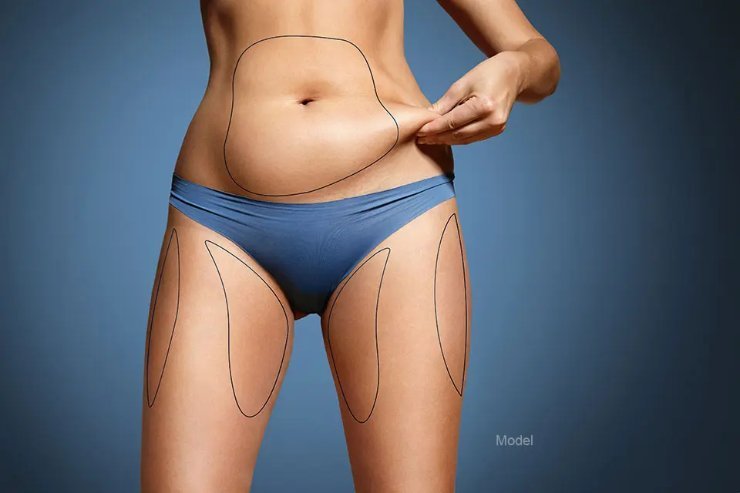
Commonly treated areas include:
- Abdomen and waist
- Flanks and back
- Hips and outer thighs
- Inner thighs
- Buttocks
- Upper arms
- Chest, including gynaecomastia in men
- Neck and under the chin
- Knees and calves
Am I a suitable candidate?
Liposuction works best in patients with localised fat and good skin elasticity, so the skin retracts smoothly over the new contour. Where skin quality is poor, removing fat can leave loose or irregular skin — in these cases a skin-removal procedure such as abdominoplasty or a body lift is usually more appropriate, either instead of or alongside liposuction.
Generally, candidates are:
- Close to a stable, healthy weight
- Troubled by localised fat deposits resistant to diet and exercise
- Of good skin elasticity
- Physically healthy, with well-controlled medical conditions
- Non-smokers, or willing to stop before and after surgery
- Realistic about the modest, contour-focused nature of the result
Referral requirement. All patients require a referral from a GP or another specialist before their first consultation. If it is deemed that your surgery is cosmetic in nature and you do not qualify for a Medicare (MBS) item number, a referral is still required, in line with Australian requirements introduced in July 2023.
Psychological screening and cooling-off. Where surgery is cosmetic, Dr. Anavekar screens all patients for body dysmorphic disorder (BDD) as part of the assessment. A second consultation is required before any decision to proceed, and a minimum seven-day cooling-off period applies after that second consultation and before surgery can be booked, as required under AHPRA guidelines.
Who performs your procedure
In Australia, liposuction is offered by a wide range of practitioners, and the qualifications behind the title vary considerably.
Dr. Anavekar is a Fellow of the Royal Australasian College of Surgeons, holding the FRACS qualification in plastic and reconstructive surgery. Procedures are performed in accredited facilities, with a specialist anaesthetist where general anaesthesia is used.
Liposuction techniques
Tumescent liposuction
The most widely used approach. A solution containing local anaesthetic and adrenaline is infiltrated into the area first. This reduces bleeding and bruising, and provides pain relief. Fat is then removed through the cannula.
Power-assisted liposuction (PAL)
The cannula vibrates rapidly, allowing fat to be released more efficiently. Useful in fibrous areas and in larger treatment areas.
Ultrasound-assisted liposuction (UAL / VASER)
Ultrasound energy liquefies fat before removal. Can be helpful in fibrous areas such as the back, upper abdomen and male chest.
Fat transfer
Fat removed by liposuction can, in selected cases, be processed and transferred to another area to add volume. Some of the transferred fat is reabsorbed, and more than one procedure may be needed.
The technique used is selected based on the treatment area, the character of the fat, and the volume being removed. No single technique is superior in all situations.
What is involved
Before surgery
Before surgery, you’ll have more than one consultation, where the areas of concern are examined and marked, skin quality assessed, and expectations discussed. Photographs are taken for planning. Where surgery is cosmetic, a seven-day cooling-off period applies after your second consultation and before any booking.
You must cease smoking, and cease medications and supplements that increase bleeding risk.
On the day
Depending on the number and size of areas treated, liposuction is performed under either local anaesthetic with sedation, or general anaesthetic administered by a specialist anaesthetist. Small treatments may be performed as day surgery; larger or multiple areas may require an overnight stay.
Small incisions are made in inconspicuous positions. Tumescent solution is infiltrated, fat is removed, and the incisions are closed or left to drain. A compression garment is applied immediately.
After surgery
Arrange for someone to drive you home. Some leakage of fluid from the incision sites in the first day or two is expected. Pain relief is prescribed, and follow-up appointments monitor healing and contour.
Your recovery
Recovery varies with the number of areas treated and the volume removed. The following is a general guide only.
| TIMEFRAME | WHAT TO EXPECT |
|---|---|
| First 48 hours | Soreness, bruising and swelling. Fluid leakage from incisions. Compression garment worn continuously. |
| Week 1 | Bruising prominent. Many patients return to desk-based work towards the end of the week. |
| Weeks 2–3 | Bruising fading. Swelling still significant. Light activity resumed. |
| Weeks 4–6 | Most normal activity and exercise resumed once cleared at review. |
| 3 months | Much of the swelling has settled and contour is becoming apparent. |
| 6–12 months | Final contour emerges. Numbness and firmness in the treated area resolve gradually. |
Compression garments are typically worn for six weeks and are important to the final contour — not optional. Swelling after liposuction is persistent and takes far longer to settle than most patients expect; judging the result before six months is premature.
Lymphatic massage is sometimes recommended to assist with swelling.
Potential benefits
Liposuction may:
- Reduce localised fat deposits resistant to diet and exercise
- Improve body proportion and contour
- Improve fit of clothing
- Treat gynaecomastia in men, where fat is the predominant component
Outcomes vary between individuals and cannot be guaranteed. Results depend on your anatomy, skin elasticity, healing and the agreed plan. Liposuction does not treat loose skin, cellulite or stretch marks, and it is not a substitute for weight management.
Risks and complications
All surgery carries risk, and complications can occur.
Key risks include:
- General surgical and anaesthetic risks — bleeding, infection, blood clots, and delayed wound healing
- Contour irregularities — lumpiness, rippling, dents or asymmetry, which may require revision
- Loose or lax skin where skin does not fully retract over the new contour
- Altered or lost sensation in the treated area, usually temporary but occasionally permanent
- Prolonged swelling and firmness, which can persist for many months
- Seroma — a collection of fluid requiring drainage
- Fat embolism — rare but serious, where fat enters the bloodstream
- Damage to underlying structures, including internal organs where liposuction is performed on the abdomen — rare, but recognised
- Dissatisfaction with the aesthetic outcome
Risk increases with the volume of fat removed and the number of areas treated in one operation. This is one reason large-volume liposuction is approached cautiously and, where extensive contouring is needed, staged across procedures.
This is a summary, not a complete list. Dr. Anavekar will discuss the risks relevant to your individual circumstances, medical history and chosen technique in detail during your consultation, and again before you provide informed consent. Please raise any concerns with her directly.
Costs
The total cost includes the surgeon's fee, the anaesthetist's fee, facility fees, compression garments and follow-up care. Cost varies considerably with the number and size of areas treated, and whether general anaesthetic and an overnight stay are required.
Liposuction performed for cosmetic reasons does not attract a Medicare rebate. Where it forms part of a reconstructive procedure, or treats a recognised medical condition, an item number may apply — assessed individually.
You will receive a written quote setting out all costs before committing to surgery, as part of the informed financial consent process. For questions about fees, contact the practice on 03 9075 0005.
Frequently asked questions
Is liposuction a weight loss procedure?
No. It removes localised fat to improve contour. The volume that can be safely removed is limited, and it does not treat obesity. Patients close to a stable weight get the best results.
Will the fat come back?
Fat cells removed from the treated area do not return. However, remaining fat cells can enlarge with weight gain, and fat can accumulate in untreated areas. A stable weight preserves the result.
Does liposuction help loose skin or cellulite?
No. Liposuction removes fat beneath the skin but does not tighten skin or improve cellulite. Where loose skin is the main concern, a skin-removal procedure such as abdominoplasty or a body lift is more appropriate.
How many areas can be treated at once?
This depends on the size of the areas and the total volume involved. Treating too much in one operation increases risk, so extensive contouring is sometimes staged. Dr. Anavekar will advise at consultation.
How long until I see the result?
Swelling after liposuction is persistent. Contour becomes apparent around three months and continues refining to around six to twelve months.
Do I have to wear the compression garment?
Yes. Garments are worn for around six weeks and materially affect the final contour and swelling. This is one of the most important things you control in your recovery.
Is liposuction painful?
Expect soreness, bruising and a deep ache in the treated areas, generally described as similar to significant muscle soreness. Pain relief is prescribed.
About Dr. Anavekar
Dr. Namrata Anavekar is a Fellow of the Royal Australasian College of Surgeons and a specialist plastic and reconstructive surgeon. She graduated with honours from Monash University and completed the Australian Plastic Surgery Training Program, with rotations through St Vincent's Hospital, The Royal Children's Hospital, The Alfred and The Austin, followed by an international fellowship in Switzerland and France.
Dr. Anavekar is a board member of the Australasian Society of Aesthetic Plastic Surgeons (ASAPS) and has authored multiple research publications. She holds several public and private hospital appointments, and is a professional member of ASAPS, the Australian Society of Plastic Surgeons (ASPS), the Royal Australasian College of Surgeons (RACS), the Australian Medical Association (AMA), and the International Society of Aesthetic Plastic Surgery (ISAPS).
She consults from Bulleen and Sunbury, Melbourne.
Related procedures
Ready to take the next step?
Book a consultation with Dr. Anavekar to discuss your goals in a warm and supportive environment.
Book a ConsultationCall 03 9075 0005Important: In accordance with AHPRA guidelines, a minimum 7-day cooling-off period applies after your second cosmetic surgery consultation and before any procedure. The information on this page is for general educational purposes only and does not constitute medical advice. Individual results vary. A consultation with a Specialist Plastic Surgeon is required to discuss your suitability.