Rhinoplasty
Rhinoplasty, commonly known as nose surgery, is performed to reshape or reconstruct the nose for cosmetic, structural, or functional reasons. Rhinoplasty may improve nasal balance while also addressing breathing concerns. A thorough consultation is essential to discuss your individual goals and suitability.
What is rhinoplasty?
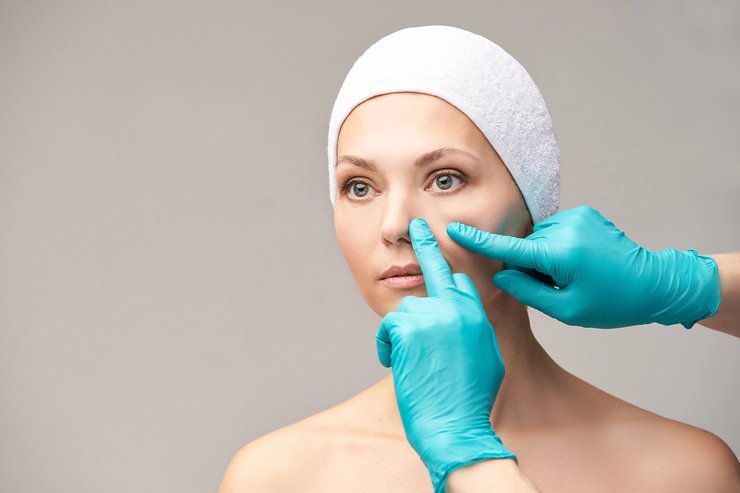
Rhinoplasty is surgery to reshape the nose. It may be performed to change the appearance of the nose, to improve nasal breathing, or both together. The nose sits at the centre of the face and small changes have a noticeable effect, which is why rhinoplasty is considered one of the most technically demanding procedures in plastic surgery.
The nose is a structure of bone, cartilage and soft tissue, all covered by skin of varying thickness. Reshaping it means altering that underlying framework while maintaining the support the nose needs to function — a nose that looks better but breathes worse is not a successful result.
Patients commonly consider rhinoplasty for:
- A dorsal hump along the bridge of the nose
- A nasal tip that is bulbous, drooping or under-projected
- A nose that appears too large or too wide for the face
- Deviation or crookedness, often following injury
- Difficulty breathing through the nose
- Asymmetry of the nostrils
- Dissatisfaction with a previous rhinoplasty
Cosmetic and functional rhinoplasty
Rhinoplasty divides into two overlapping purposes, and which applies to you affects both the surgical plan and the funding pathway.
Functional rhinoplasty
Performed to improve nasal airway obstruction. Common causes include a deviated septum, collapse of the nasal valve, enlarged turbinates, or deformity following trauma. Septoplasty — straightening the septum — is frequently performed as part of this.
Cosmetic rhinoplasty
Performed to change the appearance of the nose.
Combined
Many patients have both. A nose broken in childhood may be both crooked and obstructed. Where a functional problem exists, addressing it at the same time as reshaping is usually sensible, since both involve working on the same structures.
Where there is a documented functional problem, part of your surgery may attract a Medicare rebate even if cosmetic changes are made at the same time. The cosmetic component remains a private cost. Eligibility is assessed individually and often requires examination, and sometimes imaging, to document the obstruction.
Am I a suitable candidate?
Generally, candidates are:
- Physically mature — facial growth should be complete, ideally from 18 years of age
- In good general health, with well-controlled medical conditions
- Non-smokers, or willing to stop well before and after surgery
- Troubled by a specific, describable concern rather than a general dissatisfaction
- Realistic about what can be achieved given their skin thickness, cartilage strength and facial proportions
Skin thickness matters more than most patients realise. Thick skin conceals fine definition and limits how much refinement is visible; thin skin shows every underlying irregularity. Neither is better — but they set different limits, and understanding yours is part of a realistic discussion.
Referral requirement. All patients require a referral from a GP or another specialist before their first consultation. If it is deemed that your surgery is cosmetic in nature and you do not qualify for a Medicare (MBS) item number, a referral is still required, in line with Australian requirements introduced in July 2023.
Psychological screening and cooling-off. Where surgery is cosmetic, Dr. Anavekar screens all patients for body dysmorphic disorder (BDD) as part of the assessment — particularly relevant in rhinoplasty, where BDD is more commonly encountered than in most other procedures. A second consultation is required before any decision to proceed, and a minimum seven-day cooling-off period applies after that second consultation and before surgery can be booked, as required under AHPRA guidelines.
Rhinoplasty techniques
Open rhinoplasty
A small incision across the columella — the strip of skin between the nostrils — followed by internal nasal incisions which are concealed. This allows the skin to be lifted and offers wide exposure of the underlying nasal framework. It leaves a small scar that is generally inconspicuous.
Closed rhinoplasty
All incisions are made inside the nostrils, leaving no external scar. Access and direct visibility are more limited.
Septoplasty
Straightening a deviated septum to improve airflow. Frequently combined with rhinoplasty. A Medicare item number may be applicable if eligibility criteria are met.
Preservation rhinoplasty
Techniques that reshape the dorsum by preserving rather than removing and rebuilding the natural bridge structure. Suitable for selected patients.
Revision rhinoplasty
Surgery to correct an unsatisfactory previous result. Substantially more complex, because scar tissue distorts the anatomy and cartilage may need to be grafted from the septum, ear or rib. Outcomes are less predictable than in first-time surgery.
What is involved
Before surgery
Before surgery, you’ll have more than one consultation, where your nose is examined externally and internally, breathing assessed, skin thickness and cartilage strength evaluated, and photographs taken from standard views. Time is spent understanding what concerns you — clear goals help produce the best outcomes in rhinoplasty.
A mandatory seven-day cooling-off period applies where surgery is cosmetic. You must cease smoking, and cease medications and supplements that increase bleeding risk.
On the day
Surgery is usually performed under general anaesthetic administered by a specialist anaesthetist, in an accredited private hospital. The length of your operation depends on the complexity of the reshaping, whether septal work is included, and whether grafts are required. Many patients go home the same day; many stay overnight.
Incisions are made in the agreed position, bone and cartilage are reshaped, grafts placed where support is needed, and the skin redraped. A splint is applied to the outside of the nose, and internal splints or soft dressings are sometimes used.
After surgery
Your nose will feel blocked and you will breathe through your mouth initially — although this is uncomfortable, it improves significantly during the initial 1–2 weeks. Sleeping elevated is important. Bruising around the eyes is common and often more noticeable than the nose itself.
Your recovery
Rhinoplasty has a short initial recovery but an unusually long final one. The following is a general guide only.
| TIMEFRAME | WHAT TO EXPECT |
|---|---|
| First 48 hours | Nasal blockage, swelling, and bruising around the eyes. Head elevated. Splint in place. |
| Week 1 | Internal splint, when used, removed around day seven. Bruising fading. Nose looks swollen and unfamiliar. |
| Week 2 | External thermoplastic splint is often removed at this time. Most bruising resolved and often concealable. Many patients return to work. |
| Weeks 3–6 | Swelling settling steadily. No contact sport or activity risking a knock to the nose. |
| 3 months | Much of the swelling gone. Shape becoming recognisable. |
| 6–12 months | Continued refinement, particularly of the tip. |
| 12–24 months | Final result. Thicker skin takes longer; tip swelling is the last to resolve. |
Patience is essential after rhinoplasty. The nose is swollen for several months — it can sometimes take 18–24 months for the swelling to completely resolve. Judging your result at three months is premature, and revision is rarely considered before twelve months.
Potential benefits
Rhinoplasty may:
- Reduce a dorsal hump and straighten the profile
- Refine or reposition the nasal tip
- Improve symmetry and straighten a deviated nose
- Bring the nose into better proportion with the rest of the face
- Improve nasal breathing where a functional problem is addressed
Outcomes vary between individuals and cannot be guaranteed. Results depend on your skin thickness, cartilage strength, underlying bone structure, healing and the agreed surgical plan. Surgery works within your existing anatomy rather than producing any chosen shape.
Risks and complications
All surgery carries risk. Rhinoplasty is technically demanding, healing is prolonged and partly unpredictable, and complications can occur.
Key risks include:
- General surgical and anaesthetic risks — bleeding, infection, and delayed wound healing
- Nosebleeds, occasionally significant, in the early post-operative period
- Persistent swelling, particularly of the tip, which can take up to two years to fully resolve
- Breathing difficulty — new or worsened nasal obstruction, including internal valve collapse
- Asymmetry or irregularity of the bridge or tip, including visible or palpable edges
- Altered sensation of the nasal skin or tip, usually temporary
- Septal perforation — a hole in the septum, uncommon but recognised
- Scarring — a small columellar scar with open technique, and internal scarring that can affect airflow
- Need for revision surgery — rhinoplasty has one of the higher revision rates in plastic surgery. This is due to the unpredictable nature of internal scarring and its impact on cartilaginous tissues as well as skin
- Dissatisfaction with the aesthetic outcome
This is a summary, not a complete list. Dr. Anavekar will discuss the risks relevant to your individual circumstances, medical history and chosen technique in detail during your consultation, and again before you provide informed consent. Please raise any concerns with her directly.
Costs and Medicare
The total cost includes the surgeon's fee, the anaesthetist's fee, hospital fees and follow-up care, and varies with complexity — revision surgery and cases requiring cartilage grafts are more involved.
Purely cosmetic rhinoplasty does not attract a Medicare rebate. Where a documented functional problem exists — a deviated septum, nasal valve collapse, or obstruction following trauma — an item number may apply to that component of the surgery (typically MBS item 41671 for septoplasty, or within the 45632–45650 range for functional rhinoplasty), with the cosmetic component remaining a private cost. Private health insurance may contribute to hospital costs where an item number applies, subject to your level of cover and waiting periods.
Eligibility requires clinical assessment of your airway and cannot be determined from photographs or over the phone. We encourage you to check with your private health fund and Medicare about your eligibility for relevant rebates ahead of your appointment, as this can give you a clearer picture of your likely out-of-pocket cost. If you have had previous nasal trauma or have seen an ENT specialist, bring those records to consultation.
You will receive a written quote setting out all costs and any expected rebates before committing to surgery. For questions about fees, contact the practice on 03 9075 0005.
Frequently asked questions
Is rhinoplasty covered by Medicare?
Purely cosmetic rhinoplasty is not. Where there is a documented functional problem such as a deviated septum or nasal obstruction, an item number may apply to that part of the surgery. Assessment of your airway is needed to determine this.
How long until my nose looks normal?
An external splint is worn continuously for 2 weeks. An internal splint is worn for 1–2 weeks. Most swelling resolves by three to six months, with the tip continuing to refine for up to two years — longer if your skin is thick.
Open or closed rhinoplasty — which is better?
Neither is universally better. Open rhinoplasty offers broader visualisation of the internal nasal structures, at the cost of an external, albeit small and inconspicuous scar. Closed rhinoplasty has no visible scars, however the visualisation of the entire nose is reduced when compared to an open technique.
Will I need revision surgery?
Rhinoplasty has one of the higher revision rates in plastic surgery. Most patients do not need it, but it is a genuine possibility rather than a remote one. Revision is never considered before twelve months, as the nose is still changing.
What age can rhinoplasty be performed?
Generally once facial growth is complete — generally from 18 years onward. Operating earlier risks the result changing as the face continues to develop. It is also preferable for the patient to consent to the operation for themselves, rather than a parent or guardian.
Can you show me what I will look like?
Simulation can help communicate goals, but it is a discussion tool, not a promise. Surgery works within your existing bone, cartilage and skin thickness, and no image can guarantee an outcome. Furthermore, as swelling and scarring are unpredictable, there can be no guarantee of results.
Will breathing be affected?
Rhinoplasty should preserve or improve breathing. Where reshaping weakens support, grafts are used to maintain the airway. New or worsened obstruction remains a recognised risk and is discussed during your consultation.
Why Evolve
Dr. Namrata Anavekar is a Fellow of the Royal Australasian College of Surgeons and a specialist plastic and reconstructive surgeon. She graduated with honours from Monash University and completed the Australian Plastic Surgery Training Program, with rotations through St Vincent's Hospital, The Royal Children's Hospital, The Alfred and The Austin, followed by an international fellowship in Switzerland and France.
Dr. Anavekar is a board member of the Australasian Society of Aesthetic Plastic Surgeons (ASAPS) and has authored multiple research publications. She holds several public and private hospital appointments, and is a professional member of ASAPS, the Australian Society of Plastic Surgeons (ASPS), the Royal Australasian College of Surgeons (RACS), the Australian Medical Association (AMA), and the International Society of Aesthetic Plastic Surgery (ISAPS).
She consults from Bulleen and Sunbury, Melbourne.
Related procedures
Ready to take the next step?
Book a consultation with Dr. Anavekar to discuss your goals in a warm and supportive environment.
Book a ConsultationCall 03 9075 0005Important: In accordance with AHPRA guidelines, a minimum 7-day cooling-off period applies after your second cosmetic surgery consultation and before any procedure. The information on this page is for general educational purposes only and does not constitute medical advice. Individual results vary. A consultation with a Specialist Plastic Surgeon is required to discuss your suitability.